Gaming news
Sudoku variants explained: from Killer to Samurai

Contents · 8
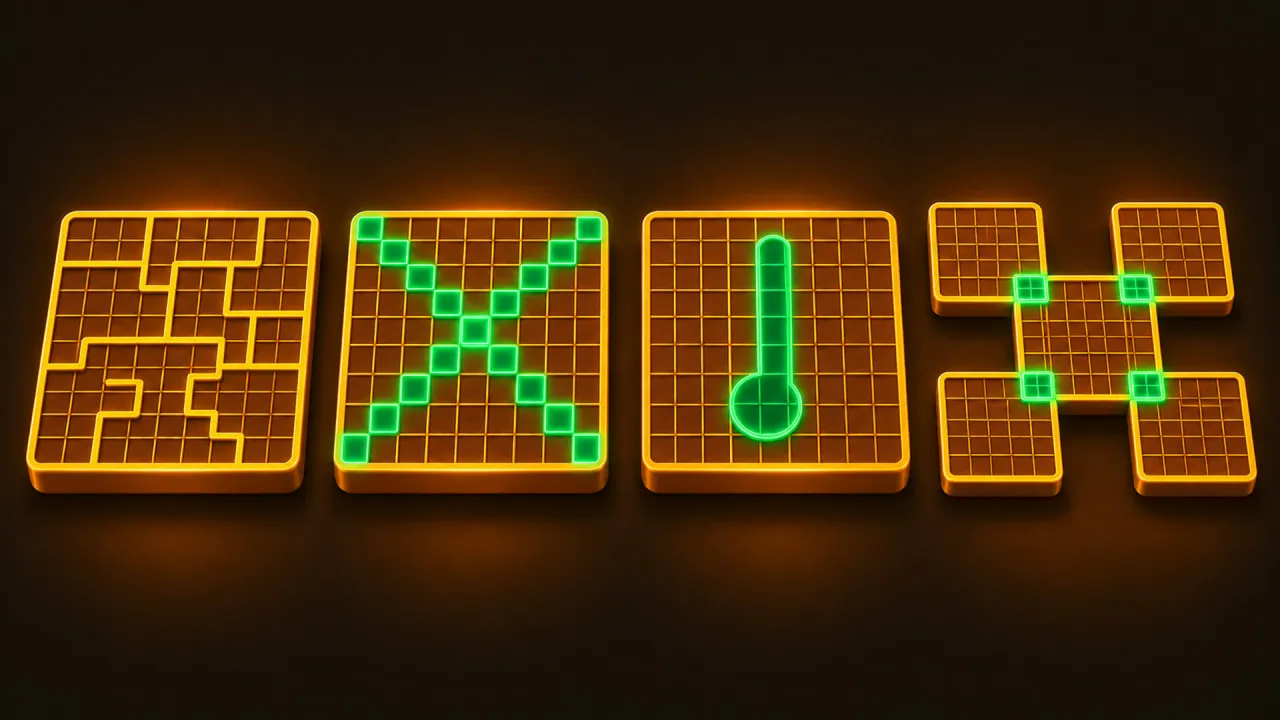
Sudoku variants keep the core rule, every digit once per row, column and region, and change one thing around it. Killer Sudoku swaps the given digits for sums. Jigsaw bends the boxes. Sudoku X and Hyper Sudoku add extra regions, Thermo adds rising sequences, and Samurai joins five grids into one. This guide explains the rules of each and what the change does to the way you solve.
The baseline: classic sudoku
A classic sudoku is a 9×9 grid divided into nine 3×3 boxes. Some digits are given, and you fill in the rest so that each row, column and box contains the digits 1 to 9 once. Every variant below starts from this rule.
The modern puzzle first appeared in 1979 in a Dell puzzle magazine under the name Number Place, most likely designed by the American architect Howard Garns. The Japanese publisher Nikoli introduced it to its readers in 1984 and later shortened the long original title to Sudoku. The Times in London began printing it in November 2004, and Killer Sudoku followed in the same paper in 2005.
Killer Sudoku: sums instead of givens
A Killer Sudoku usually starts with an empty grid. The cells are grouped into cages, each marked with a small number. The digits in a cage must add up to that number, and no digit may repeat inside a cage. The normal row, column and box rules still apply. The puzzle is usually credited to the Japanese setter Tetsuya Nishio and first appeared outside Japan in The Times in 2005.
Two ideas carry most of the solving. First, some cages have only one possible combination: a two-cell cage with the sum 4 must hold 1 and 3, and a three-cell cage with the sum 24 must hold 7, 8 and 9. Second, the rule of 45: every row, column and box adds up to 45. If the cages inside a box cover all but one of its cells, subtract their sums from 45 and you have that cell.
Jigsaw Sudoku: boxes that bend
Jigsaw Sudoku, also called irregular or nonomino sudoku, replaces the nine square boxes with nine irregular regions of nine cells each. Rows and columns work as usual, and each region must contain 1 to 9.
The change sounds small, but it removes a habit you may not know you have: scanning in bands of three rows. A region can stretch across many rows, so you have to trace its outline every time.
In return you get a technique that only works with irregular regions, the Law of Leftovers. Take a block of rows and the same number of regions that mostly cover it. The cells of those regions that poke out of the block and the cells inside the block that belong to other regions must hold the same digits.
Sudoku X and Hyper Sudoku: extra regions
Sudoku X adds one rule: each of the two main diagonals must also contain the digits 1 to 9 once. The center cell lies on both diagonals, and every diagonal cell is restricted by more cells than in a classic grid, which makes the diagonals a good place to start.
Hyper Sudoku adds four extra 3×3 regions, usually shaded, in rows 2 to 4 and 6 to 8 and columns 2 to 4 and 6 to 8. Each must contain 1 to 9. The format was introduced in the Dutch newspaper NRC Handelsblad by Peter Ritmeester and is also known as Windoku or NRC Sudoku.
The four windows create five more groups of nine cells that must also contain 1 to 9. The easiest one to see: the nine cells where rows 1, 5 and 9 cross columns 1, 5 and 9. Treat them like an extra box.
Thermo Sudoku: digits that rise
In a Thermo Sudoku, thermometer shapes are drawn over some of the cells. Along each thermometer, the digits must strictly increase from the round bulb to the flat end. According to Grandmaster Puzzles, the puzzle blog started by three-time world sudoku champion Thomas Snyder, the name was first used for this style in the book Mutant Sudoku by Wei-Hwa Huang and Snyder.
Length is the clue. Every step has to go up by at least one, so a thermometer of six cells cannot start higher than 4 or end lower than 6, and a thermometer of nine cells can only read 1 to 9 in order. Long thermometers give you narrow ranges at both ends before you have placed a single digit.
Samurai and other sizes: more grids, bigger grids, smaller grids
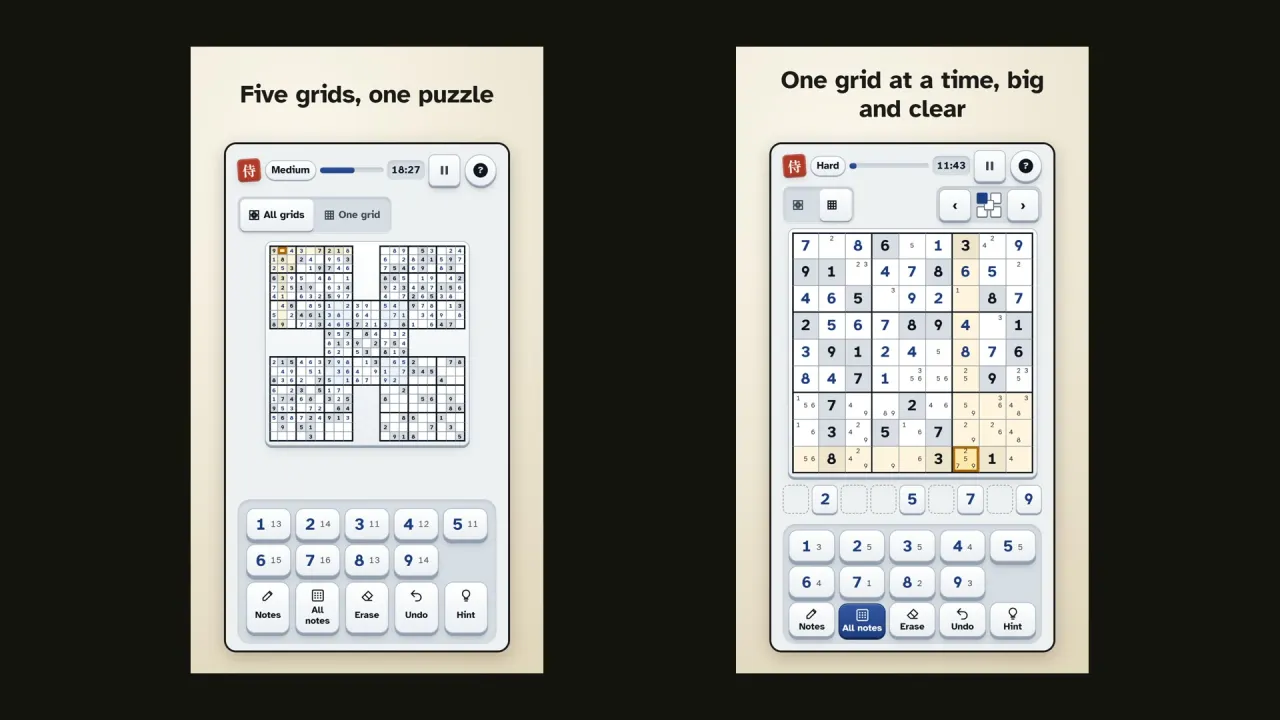
Samurai Sudoku joins five 9×9 grids in an X shape. Each corner grid shares one box with the center grid, and the digits there have to satisfy both. In Japan it is called Gattai 5, roughly five merged, and other merged layouts with fewer grids or different overlaps exist as well. Our guide to Samurai Sudoku rules and strategy explains where to start.
Size can change without any overlap too. A 6×6 mini sudoku uses the digits 1 to 6 and regions of 3×2 cells, a format that has appeared in USA Today. In the other direction, Dell publishes 16×16 puzzles under the name Number Place Challenger, and Nikoli offers 25×25 grids called Sudoku the Giant.
Which sudoku variant should you try first?
Pick by what you enjoy, and start one difficulty level below your usual classic level, because at first the new rule is the hard part.
If you want a gentle step away from classic sudoku, try Sudoku X or Hyper Sudoku: the grid looks familiar, and the extra regions give you more to work with. If you like arithmetic, Killer is the natural choice. Jigsaw changes the most about how you read the grid. Thermo suits solvers who enjoy short chains of reasoning, and Samurai is for long, calm sessions.
A note on our own work: one of our teams at ARI GG ATO is preparing a game called Samurai Sudoku. It is coming soon and cannot be played yet. Its game page lists the multi-grid family, Samurai, Twin, Triple, Butterfly, Sohei, Kazaguruma and Flower, plus a classic 9×9. It does not list Killer, Jigsaw, Sudoku X, Hyper or Thermo.

Sudoku variants: quick answers
What is the easiest sudoku variant for beginners?
A 6×6 mini sudoku, because it is the classic rule on a smaller grid. Among the 9×9 variants, Sudoku X changes the least: classic rules plus two diagonals.
Does Killer Sudoku have starting digits?
Usually not. The grid starts empty, and the cage sums are the only clues.
Are Hyper Sudoku, Windoku and NRC Sudoku the same puzzle?
Yes. All three names describe a classic grid with four extra 3×3 regions.
Do sudoku variants need math?
Only Killer Sudoku, and there it is addition up to 45. Jigsaw, Sudoku X, Hyper, Thermo and Samurai are pure logic, like the classic puzzle.
What does Gattai mean in sudoku?
It is Japanese for merged. A number after it gives the count of overlapping 9×9 grids, so Gattai 5 is the Samurai layout.

Done reading? Try it yourself.
Every game with one account – free. Collect GG Coins and climb the ranking.