Gaming news
Mahjong vs. Mahjong Solitaire: two very different games

Contents · 8
Mahjong vs. Mahjong Solitaire, in short: Mahjong is a game for four players who draw and discard tiles to complete a hand, a little like rummy. Mahjong Solitaire is a puzzle for one player who removes matching pairs from a stack. They share a set of tiles and part of a name. The rules, the skills and the history are different.
What the two games share: the tiles
Both use the Chinese mahjong set. A full set has 144 tiles: three suits (dots, bamboo and characters) numbered 1 to 9 with four copies each, four winds and three dragons with four copies each, plus four flowers and four seasons.
The difference starts with what the tiles mean. In Mahjong Solitaire a tile is only a picture, and the one question is whether two pictures match. In Mahjong, suit and number matter on every turn: a 4, 5 and 6 of bamboo form a set, while a 4 of bamboo, a 5 of dots and a 6 of characters do not.
How four-player Mahjong works
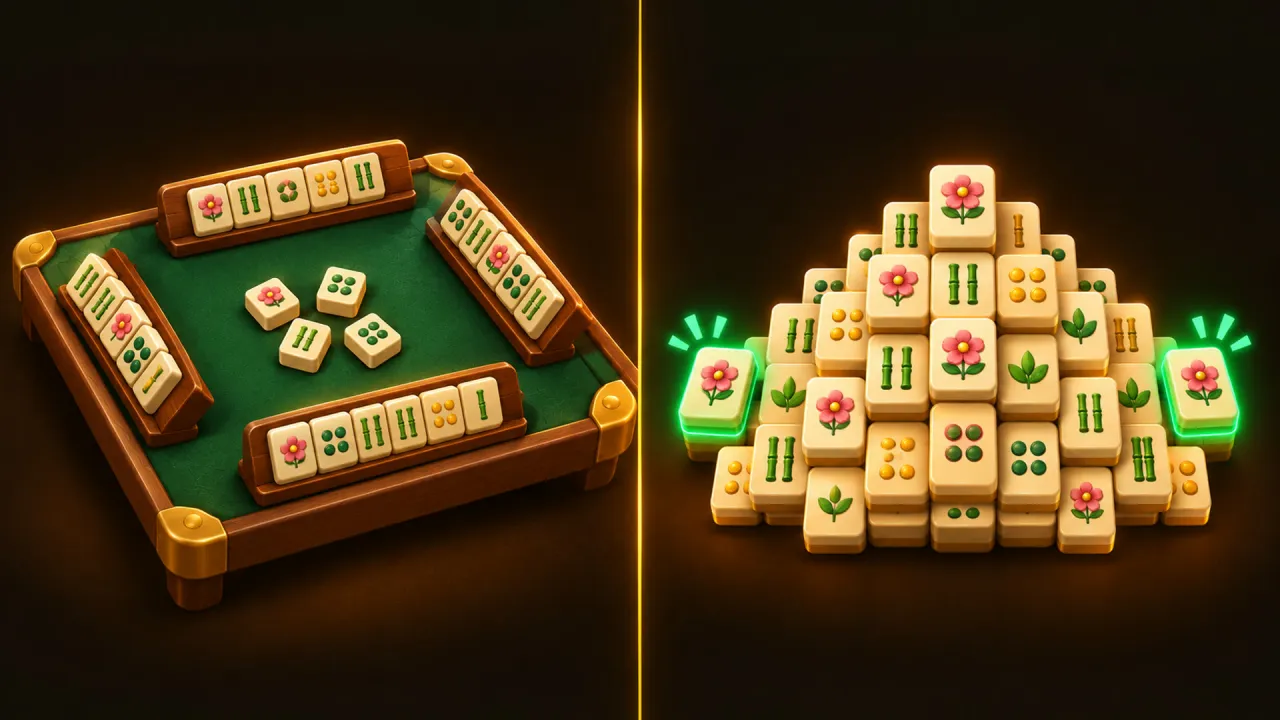
Mahjong developed in China in the 19th century. In its usual form, four players sit around a table, and each holds 13 tiles that the others cannot see. On your turn you draw a tile and discard one. The goal is to be the first to complete a legal hand of 14 tiles, in most rule sets four sets and a pair.
A set is a chow (three consecutive numbers in one suit), a pung (three identical tiles) or a kong (four identical tiles). You can also claim a tile another player has just discarded if it completes one of your sets. That is where the depth comes from: every discard gives something away, and every tile you keep may be one an opponent is waiting for.
Luck decides which tiles you draw. Skill decides what you keep, what you throw and when you settle for a cheap hand instead of chasing an expensive one. Scoring is where the regional versions differ most.
Three styles you will hear about
Hong Kong style. A form with few special rules and a comparatively simple scoring system, which is why it is often used to explain the game. It uses all 144 tiles, with the flowers and seasons as bonus tiles, and counts the value of a hand in units called faan.
Riichi (Japanese) Mahjong. Usually played with 136 tiles, because the flowers and seasons are left out. A winning hand needs at least one yaku, a recognized scoring pattern. The name comes from the riichi declaration: a player whose concealed hand is one tile from winning can stake 1,000 points and announce it, and from then on the hand is fixed. The World Riichi Championship maintains an international rule set.
American Mahjong. Played with 152 tiles, including eight jokers. A round starts with the Charleston, a sequence of tile passes between the players. To win, your tiles must match one of the hands on a printed card, and the National Mah Jongg League issues a new card every year.
How Mahjong Solitaire works
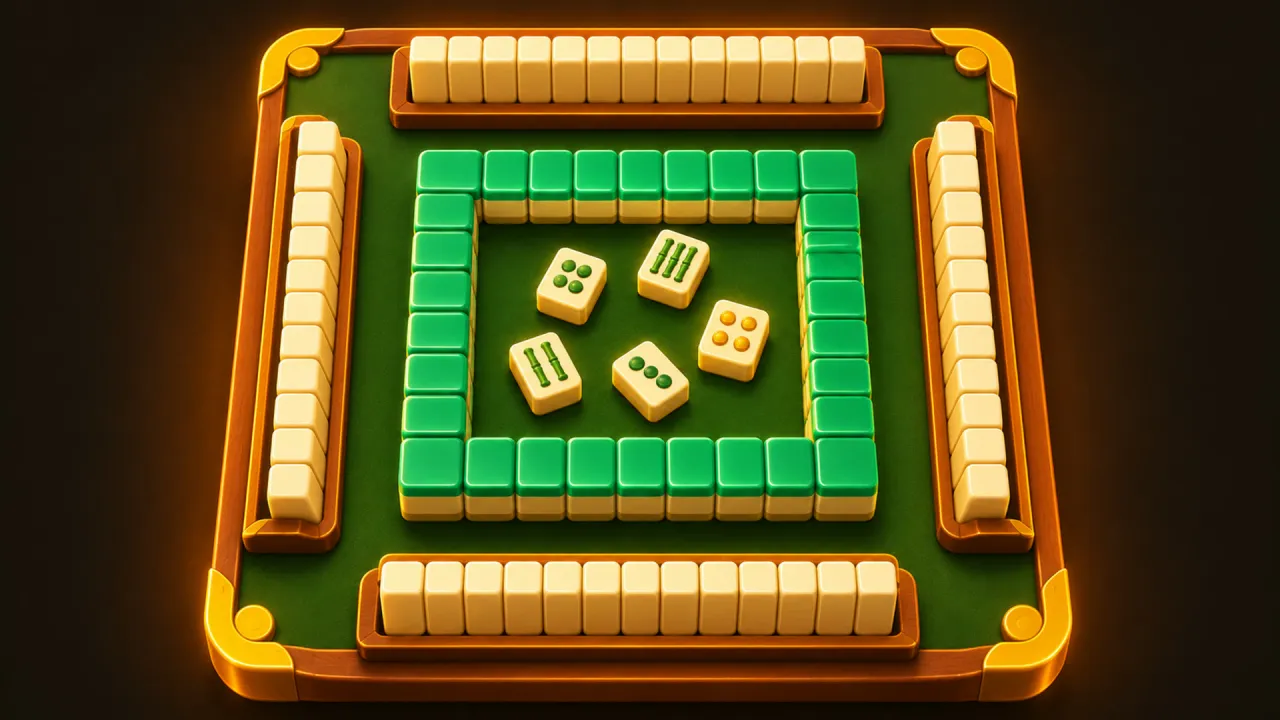
Mahjong Solitaire has no hands, no discards and no opponents. The tiles are stacked face up in a layout, classically a pyramid shape known as the turtle. You remove two identical tiles at a time, and only tiles that are free: nothing on top, and open on the left or right side. Any flower pairs with any flower, any season with any season. Clear every tile and you win.
The skill is planning the order. Every pair you remove changes which tiles become reachable, and a careless match can make the board unsolvable. Our guides cover the Mahjong Solitaire rules and 12 tips for clearing more boards.
Where the solitaire game came from
The puzzle as we know it is a product of the computer era. Brodie Lockard programmed the first computer version in 1981 on the PLATO system and named it Mah-Jongg, after the game whose tiles it uses. In 1986 Activision published it as Shanghai for home computers.
Shanghai was marketed as based on a centuries-old Chinese game called the Turtle, a claim Lockard himself did not make. What is well documented is the software history. Microsoft shipped a version called Taipei in its Entertainment Pack for Windows in 1990, and most editions of Windows Vista and Windows 7 came with Mahjong Titans.
Why the names get mixed up
Lockard named his program after the tiles, and many later versions shortened the title to plain Mahjong. Shipped with Windows, the puzzle reached people who had never seen the four-player game, which helps explain why many people know the name only from the puzzle.
If you are unsure what a game is, read its description. Pairs, layouts, levels and hints point to Mahjong Solitaire. Four players, hands, discards, pung or riichi point to Mahjong. Some sources call the four-player game mahjong rummy to keep the two apart, and the puzzle also goes by Shanghai solitaire or Taipei.
Which one should you play?
Choose Mahjong Solitaire if you want something you can learn in five minutes and play alone in short sessions. It rewards patience and planning, and nobody waits for your move.
Choose Mahjong if you like playing against people and do not mind a learning curve. You need to pick a rule set, find three opponents at a table or online, and give yourself time to get used to the scoring. In return you get things the puzzle does not have: reading opponents, defending against their hands and the tension of a hidden hand.
Nothing stops you from playing both. One of the two is on this site: Zenith Mahjong, made by one of our teams at ARI GG ATO, is a Mahjong Solitaire game despite the short name. It is playable in the browser on ariggato.com and available on Google Play.
Mahjong vs. Mahjong Solitaire: quick answers
Is Mahjong Solitaire real Mahjong?
No. It uses the same tiles, but it is a matching puzzle for one player. Mahjong is a game for four players built around drawing, discarding and completing a hand.
Does Mahjong Solitaire teach me to play Mahjong?
Only a little. With a classic tile set you learn to recognize the suits, winds and dragons, which helps. You do not learn sets, discards or scoring, and those make up the four-player game.
How many tiles does each game use?
Classic Mahjong Solitaire uses 144 tiles. Hong Kong style Mahjong also uses 144, Riichi usually 136, and American Mahjong 152 including eight jokers.
Is Mahjong Solitaire an ancient Chinese game?
The computer puzzle dates from 1981. The story of an ancient origin comes from the marketing of the 1986 game Shanghai. How far back tile matching by hand goes is hard to document.
Which one is easier to learn?
Mahjong Solitaire. Its rules fit in a few sentences. Mahjong takes longer because each regional style has its own winning hands and scoring.

Done reading? Try it yourself.
Every game with one account – free. Collect GG Coins and climb the ranking.