Tips & tricks · Zenith Mahjong
Mahjong Solitaire rules: how to play in five minutes

Contents · 8
The Mahjong Solitaire rules fit in one sentence: remove pairs of identical tiles until the board is empty, and only use tiles that are free. A tile is free when nothing lies on top of it and it can slide out to the left or to the right. The rest of this guide explains those two ideas, the one exception to the matching rule, and how to play your first board.
The goal: clear the board in pairs
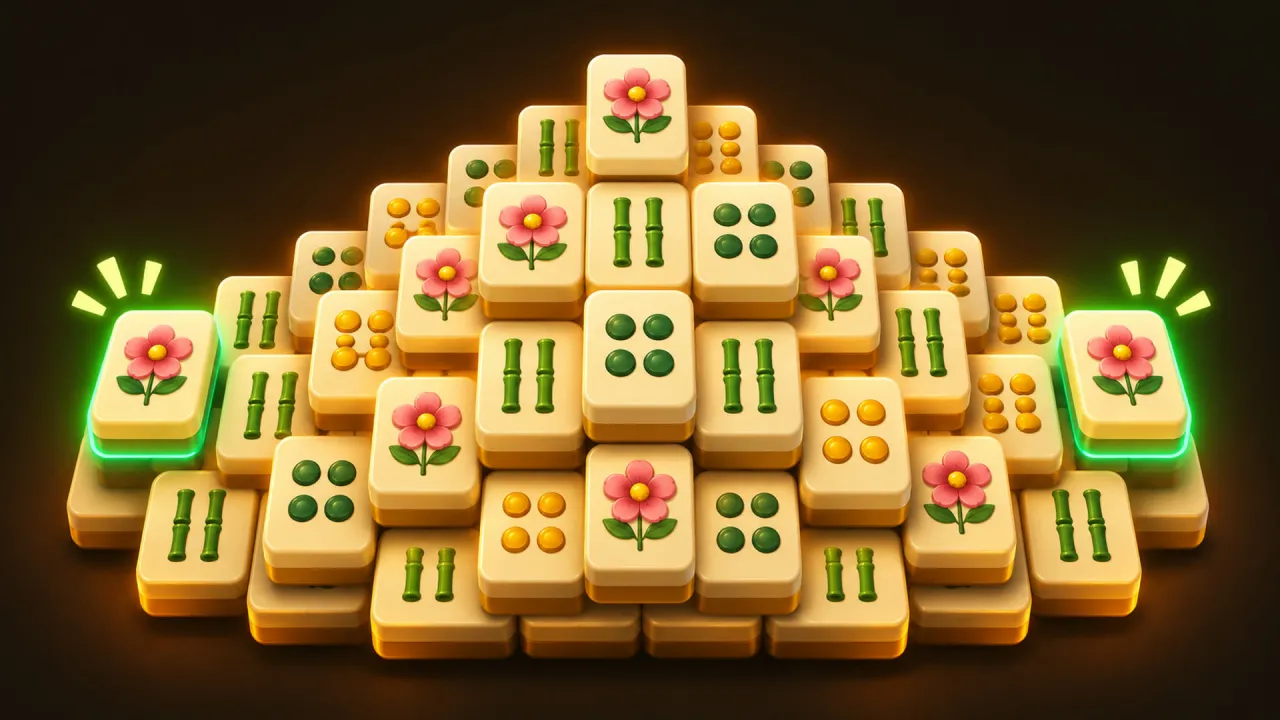
Mahjong Solitaire is a puzzle for one player. The tiles are stacked face up in a layout, usually several layers high. You pick two free tiles with the same picture, both leave the board, and the tiles they covered or blocked may become free. You win when every tile is gone. You are stuck when tiles remain but no free pair exists.
There is no opponent. The difficulty comes from order: the same board can be cleared or ruined depending on which pairs you take first.
What counts as a free tile
Two conditions must both be true. First, no other tile sits on top of the tile, not even partly. Second, at least one of its two sides, left or right, has no neighbor on the same layer. A tile wedged between two neighbors is blocked, even on the top layer. A tile at the end of a row is open on one side, and that is enough.
Tiles in the neighboring rows, toward the top or bottom of the screen, do not block anything. Only three directions count: left, right and on top.
The tile is blocked. Look for a tile from the layer above that overlaps one of its corners, or for neighbors on both sides. Many digital versions also mark blocked tiles, for example by shading them.
The tiles, and the one exception
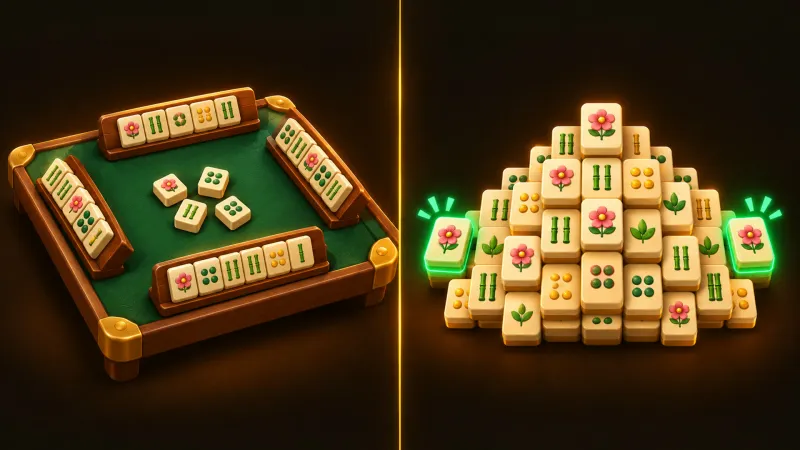
The classic game uses a full mahjong set of 144 tiles. Three suits, usually called dots, bamboo and characters, run from 1 to 9 with four copies of every tile. That makes 108 suit tiles. The honor tiles add four winds and three dragons, again with four copies each, for 28 more. The last eight are bonus tiles: four flowers and four seasons, one copy of each.
Suits, winds and dragons must match exactly: a 3 of bamboo only pairs with another 3 of bamboo. Flowers and seasons are the exception, because each of them exists only once. Any flower matches any other flower, and any season matches any other season. A flower never pairs with a season.
This is the most common reason beginners believe a board is stuck. If two free tiles show two different plants or two different seasons, they are probably a legal pair. You do not need to read the Chinese characters either. You only need to tell the pictures apart.
Your first board, step by step
- Look at the whole layout before you tap anything. Find the tallest stack and the longest rows: they hide the most tiles.
- Find two free tiles with the same picture. Check both of them: nothing on top, and one side open.
- Tap one, then the other. Both disappear, and you see what they were holding back.
- Prefer pairs that uncover or unblock other tiles. A pair that frees nothing can wait.
- Remember that flowers pair with flowers and seasons with seasons, even when the artwork differs.
- Repeat until the board is empty. If no free pair is left, use the help your version offers or start the deal again.
How a game ends, and why some deals cannot be won
A game ends in one of two ways: the board is empty, or no free pair remains. The second case is not always your fault. With a purely random deal, some boards have no solution at all. A computer analysis of ten million random deals of the classic turtle layout found that about 3 percent could not be solved, even by a solver that was allowed to look under the tiles.
Most digital versions avoid this by dealing only boards that can be won. That still does not protect you from your own choices: one wrong pair early on can turn a solvable board into a dead end. For that moment, games usually offer help such as a hint, an undo or a reshuffle of the remaining tiles. Which of these exist differs from game to game.
Layouts and a short history
The best-known layout is the turtle: a wide base, a pyramid in the middle and a single tile on top. Newer games add many other shapes, and some use fewer than 144 tiles. The rules stay the same on every layout. Only the shape changes how hard it is to reach the tiles you need.
The game is younger than it looks. Brodie Lockard wrote the first computer version in 1981 on the PLATO system and called it Mah-Jongg, after the tile game that lent it its pieces. Activision published it as Shanghai in 1986. Microsoft included a version called Taipei in its Entertainment Pack for Windows in 1990, and most editions of Windows Vista and Windows 7 came with Mahjong Titans.
One thing it is not: the four-player game called Mahjong. The two share the tiles and little else. We compare them in Mahjong vs. Mahjong Solitaire.
Where to practice: Zenith Mahjong
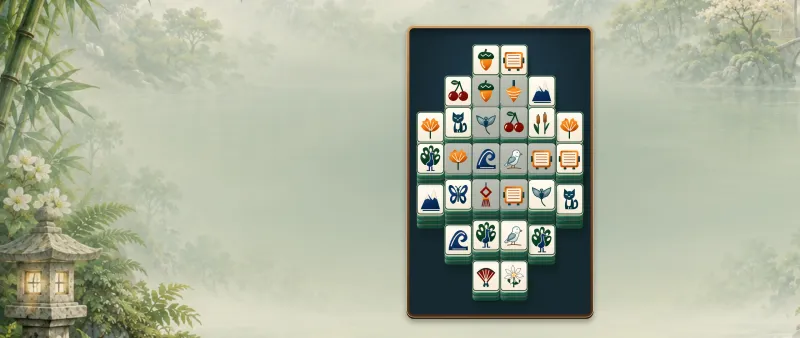
Zenith Mahjong is a Mahjong Solitaire game made by one of our teams at ARI GG ATO. You can play it in the browser on ariggato.com, and it is available on Google Play. It follows the rules described here: tap two matching free tiles, and a tile is free when no tile covers it and its left or right side is open. Instead of the traditional suits it uses illustrated tiles, and its rules screen shows playable tiles bright and blocked tiles shaded.
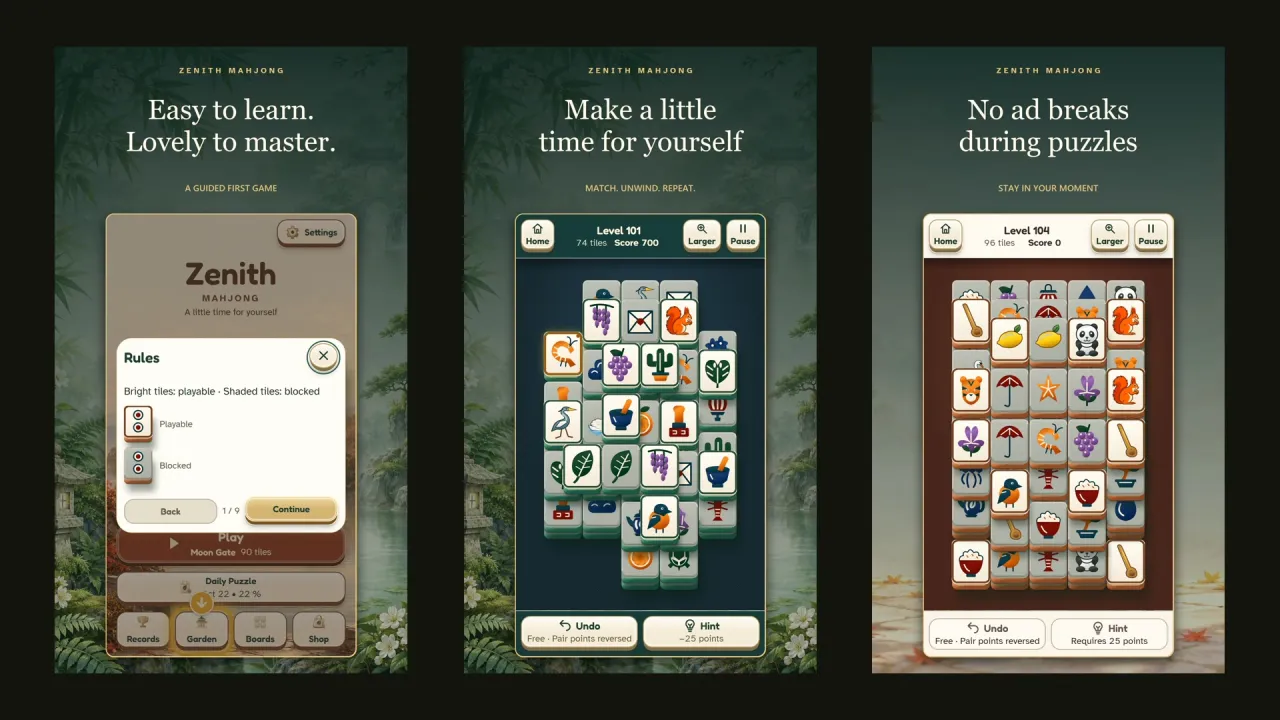
According to its game page, the initial deals have a solution and the first hint in each game is free. Once the rules feel natural, continue with our 12 Mahjong Solitaire tips.
Mahjong Solitaire rules: quick answers
Can I match any two identical tiles?
Only if both are free. Each of the two tiles needs an open left or right side and no tile on top of it.
Do flower tiles have to match exactly?
No. Any flower pairs with any other flower, and any season pairs with any other season. All other tiles need an identical partner.
How many tiles are in Mahjong Solitaire?
The classic game uses 144 tiles, which is 72 pairs. Newer layouts sometimes use fewer.
Is every Mahjong Solitaire game winnable?
Not with a random deal. In an analysis of ten million random turtle deals, about 3 percent had no solution. Most digital versions only deal boards that can be won, but a wrong move can still lead to a dead end.
Is Mahjong Solitaire the same as Mahjong?
No. Mahjong is a game for four players who draw and discard tiles to build a hand. Mahjong Solitaire is a matching puzzle for one player that uses the same tiles.